By Usman Hanif
Published in The Express Tribune on January 07, 2026
KARACHI:
Pakistan’s much-discussed economic stabilisation is masking a widening fault line: while wealthier households continue to accumulate assets and benefit from market rallies, the majority of Pakistanis are grappling with shrinking incomes, depleted savings and rising living costs.
Fresh data from the Pakistan Bureau of Statistics (PBS), compiled by Optimus Capital Management, underscores that the country is firmly in the grip of a K-shaped recovery, where prosperity is flowing upward while financial stress deepens at the bottom.
“The rich Pakistanis are becoming richer while the poor get poorer,” said Maaz Azam, Research Head at Optimus Capital Management, while talking to The Express Tribune.
Drawing on the latest Household Integrated Economic Survey (HIES), Azam highlighted how average household incomes, expenditures and savings have evolved across income quintiles between FY2019 and FY2025. The data, originally reported in rupees and converted into US dollars to remove inflation distortions, paints a sobering picture of declining real purchasing power for the “common man”.
According to the survey, average monthly household earnings in dollar terms have fallen by 3.4% overall since FY2019. However, this headline figure conceals a stark divergence. The bottom 20% of households saw their monthly income drop by nearly 12%, while the second quintile experienced a decline of over 7%. In contrast, the top quintile recorded a 7% increase in earnings over the same period, reinforcing the notion that income growth has become increasingly concentrated among higher earners.
A similar pattern emerges on the spending side. While overall household expenditure rose modestly by 4%, this increase was entirely driven by upper-income groups. The richest 20% of households expanded their spending by 13%, whereas the poorest quintile cut expenditure by more than 10%. Middle-income households largely stagnated, reflecting a squeeze that has hollowed out the urban middle class.
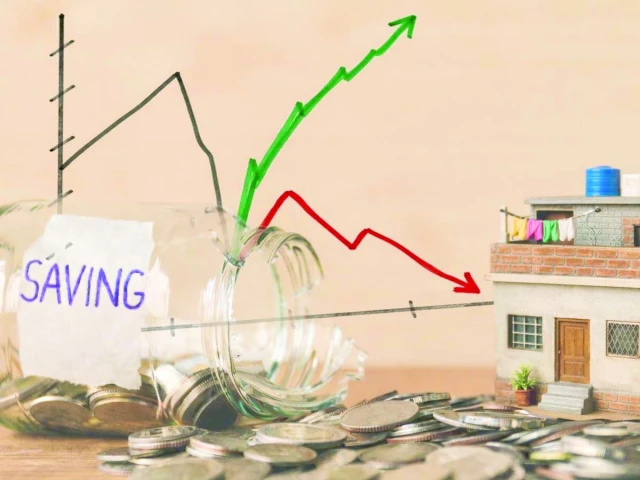
Perhaps the most alarming signal comes from household savings. Implied savings across all income groups have collapsed by 66% since FY2019. For lower-income households, savings have been nearly wiped out, leaving little buffer against economic shocks. Even the wealthiest quintile saw savings fall by more than 57%, suggesting that consumption is increasingly being financed by drawing down past reserves rather than by sustainable income growth.
“This data reflects the average Pakistani,” Azam noted, pointing out that high-net-worth individuals do not typically participate in household surveys. “The very wealthy operate outside this dataset, yet they are precisely the group benefiting most from asset price inflation.”
To reinforce the household-level findings, Optimus Capital also examined GDP per capita, a broad proxy for average income. In dollar terms, GDP per capita has declined sharply since its peak in FY2022. While projections suggest a gradual recovery, Pakistan is only expected to return to FY2017-18 income levels by FY2026, and to regain its FY2022 peak as late as 2029. This implies several years of lost income growth for the average Pakistani.
The strain on household finances is also reshaping consumption patterns. In FY2025, essentials – food, housing, energy and transport – accounted for nearly 69% of household spending, up from 66.6% in FY2019. By contrast, spending on health and education fell by 19%, a particularly troubling trend given their role in long-term productivity and social mobility. Discretionary spending also edged lower, underscoring how inflation has forced households into survival mode.
Recent PBS findings corroborate this shift. Households now devote close to 63% of total expenditure to basic necessities, while the share allocated to education has almost halved to just 2.5% over six years. Although nominal average monthly household income has nearly doubled to Rs82,179 since 2018-19, expenditures have surged even faster, up 113%, driven by persistent food and energy inflation.
These pressures are visible in sector-level data as well. Consumption-sensitive industries such as cement and beverages remain well below their historical peaks. Cement dispatches, often seen as a proxy for construction activity and household investment, have struggled to regain FY2021 levels despite intermittent recoveries. Beverage manufacturing, reflecting mass-market discretionary spending, has also failed to stage a sustained rebound. “These sectors tell you people’s pockets are empty,” Azam said. “Demand has not recovered because real incomes have not.”
Yet, on the other end of the spectrum, signs of affluence abound. Car sales in premium segments remain robust, and Pakistan’s stock market has repeatedly touched record highs. This divergence lies at the heart of the K-shaped recovery. As Azam explained, during inflationary episodes, asset prices tend to reset and recover faster than wages. Those with significant financial or real assets see their wealth multiply, while households with minimal savings or investments fall further behind.
“For an average Pakistani, savings might amount to a few hundred thousand or a couple of million rupees at most – if that,” he observed. “If there are no savings to begin with, there is nothing to grow. On the other hand, wealthy individuals with millions or billions invested benefit disproportionately when markets rebound.”