By Fariya Hashmat
Published in The News on September 29, 2026
In 1970, British chemist James Lovelock proposed an idea about Planet Earth that challenged conventional thinking. He called it the ‘Gaia Hypothesis’, stating that our planet is not just a dead rock with life on it; the Earth is life. It actively regulates itself, much like a human body.
For instance, when the human body experiences changes in temperature, it responds through automatic regulatory mechanisms — sweating when it becomes too hot and shivering when it becomes too cold. These responses occur without conscious intervention, enabling the body to maintain internal stability. Lovelock said Earth operates similarly through natural regulatory processes. The planet has been running its own thermostat for 4.5 billion years and has survived five mass extinctions; it adapts and rebuilds life. However, it doesn’t correct gently, and doesn’t send a warning letter — it sends ice ages, floods, extinction events and then starts over. The planet is not fragile; we are.
For the last two centuries, however, we have increasingly treated Earth as a resource to be exploited, with industrialisation driving a dramatic rise in greenhouse gas emissions. The Paris Agreement of 2015 established the standard of limiting global average temperature to 1.5 C. Yet the United Nations Environment Programme’s (UNEP) recent report, ‘Limiting Overshoot’, launched on September 2, warns that global temperature will soon exceed the 1.5 C limit, highlighting the urgency of taking imperative measures. The question is: are we already too late?
The warnings are increasingly visible. Catastrophic floods in Nepal, the Philippines and other parts of Asia (most recently Bangkok), severe flooding associated with Typhoon Saola in China and other extreme weather events have affected communities across different regions in recent months.
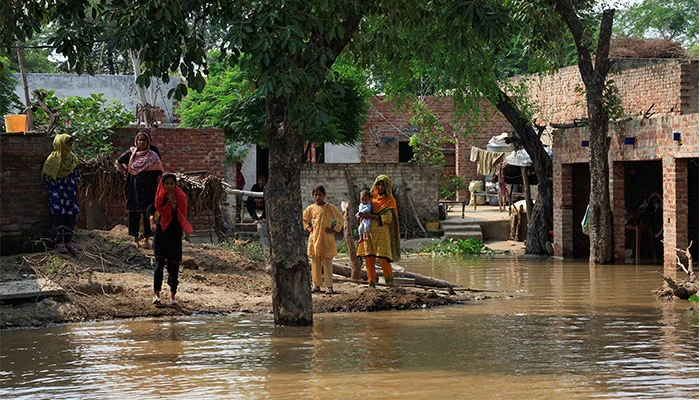
These events illustrate societies’ growing exposure to multiple climate- and weather-related hazards. But the consequences are particularly severe in the developing countries of the Global South. For instance, despite contributing less than one per cent to greenhouse gas emissions, Pakistan is highly vulnerable to climate catastrophes, primarily floods. According to the Internal Displacement Monitoring Centre (IDMC), Pakistan recorded 46 million internal displacements associated with climate-related disasters between 2008 and 2025, 45.2 million of which were caused by floods.
Such large-scale climate catastrophes expose human fragility. Entire communities are swept away and lives are lost. Survivors face physical and psychological health consequences; families lose homes, livelihoods, crops and livestock; food insecurity and economic devastation follow suit. The Gaia hypothesis reminds us of a powerful paradox: the Earth endures, but the systems and conditions that sustain humanity itself are highly vulnerable.
Can we reverse the damage we have inflicted on the planet? At this level, completely reversing it seems unlikely. Over the past two decades, things have only continued to get worse. Military activities and large-scale wars, for example, are estimated to account for about 5.5 per cent of global greenhouse gas emissions, although significant gaps remain in global reporting and measurement. At the same time, the rapid expansion of artificial intelligence is creating growing demand for water, electricity, and data-centre infrastructure. This raises the question: are our existing climate policies and initiatives actually working to contain the carbon footprint?
Although there have been commitments, agreements and targets, the impacts continue to intensify, and the most vulnerable communities continue to bear a disproportionate share of the consequences. Perhaps this is where we need to return to Lovelock’s Gaia hypothesis. The Earth does not need to save us. It has survived billions of years of environmental change and will continue to evolve long after human societies disappear. The question is whether humanity can learn to adapt quickly enough to the changing conditions of the planet on which it depends.
Rather than relying solely on authorities to respond after a disaster strikes, communities need greater capacity to prepare ex-ante. This means empowering them with local and indigenous knowledge, social networks and available community resources.
People need better information about where it is safer to build houses, how to protect their livelihoods and what to do when or if warnings are issued. Communities should not be left to face disasters alone; institutions need to work with them so local capacities complement formal emergency response. This is because by the time rescue teams reach the affected area, the damage is already done and lives are lost.
Perhaps the real lesson of Gaia is that the Earth will continue to change, but humanity needs to learn how to live, adapt and build resilience on a changing planet.