
REPORT ON
COVID–19 AND ITS IMPACT ON OUT AND RETURN OVERSEAS LABOR
MIGRATION FROM PAKISTAN: MAJOR ISSUES AND CONCERNS
(Webinar at Lahore School of Economics, Centre on International Migration,
Remittances and Diaspora (CIMRAD), June 30, 2020)
Among the wide range of issues raised and debated in CIMRAD’s webinar on June 30,
there was a consensus on three points. First, that labor migration is unlikely to return to
the pre–pandemic times in the near future but defining what the new “normal” will be and
when it will start to unfold is not possible at this time. Second, labor migration is a multi–
faceted and complex phenomenon which makes it difficult to build scenarios that would
accurately predict the future. Third, that recent decline in remittances during March–May
2020 also reflect real supply side constraints as a result of lockdown measures in labour
receiving countries and delay in payment of salaries which impacted flow of remittances
through formal channels besides loss of employment.
A few themes around which the discussion centered are as follows.
Projecting the impacts on emigration levels, returnees and labor market
By the end of June 2020, a minimum of about 100,000 Pakistanis had lost their jobs
overseas and another 102,000 were unable to proceed overseas since their work permits
could not be processed because of the lockdowns, according to data shared by Mr. Kashif
Noor, D.G., Bureau of Emigration and Overseas Employment (BEOE). According to him
these number of return and out migration will in all probability increase in the coming
months.
According to estimates presented by Dr. G.M. Arif, former Joint Director, Pakistan
Institute of Development Economics (PIDE) and a leading migration specialist, based on
alternate assumptions (high, medium and low) as many as 470,000 to 800,000 Pakistani
workers overseas may return to Pakistan following the pandemic. However, he made
clear that there had always been a steady flow of return migrants to the country preceding
the pandemic and it was difficult to ascertain exactly the additional number of returnees
as a result of the pandemic. What was important was the number that left the country to
work abroad and this number had come to a sudden halt with the onset of lockdowns in
host countries. If the number of out migrants in 2019 had remained the same in 2020,
about 600,000 workers would have gone overseas. He thus cautioned that the combined
net effect of the current stoppage of outflows and higher number of returnees is bound to
result in a massive negative impact on the domestic employment situation and a sharp
increase in the unemployment rate from the current; near 6 per cent to 9 per cent. Read More
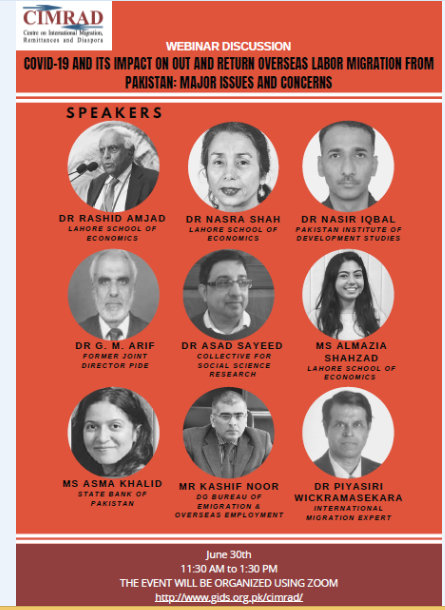
Webinar Report on Covid-19 and its Impact on Out and Return Overseas Labour Migration from Pakistan: Major Issues and Concerns
Related Posts
Eating grass for AI
Published in Dawn on October, 19, 2026 “WE will eat grass or leaves, even go hungry, but we will get one of our own … We have no other choice!” Zulfikar Ali Bhutto had famously remarked as he voiced this nation’s determination to build an indigenous nuclear deterrent programme that had, by the mid-1960s, become an existential […]

19
OctSafe spaces for women
By Zeba Sathar Published in Dawn on October, 18, 2026 THE Protection Against Harassment of Women at the Workplace Act, 2010, was an important response to problems that directly affect women. It enabled the ombudsman to hear cases, many of which were resolved in women’s favour. A recent judgement has now eliminated an avenue that many women[…]