By Shahid Iqbal
Published in Dawn on May, 21, 2026
KARACHI: Climatic disasters in Pakistan have been higher than both global and regional averages in 2000-2024, as well as in the preceding two decades, according to a detailed report by the State Bank of Pakistan (SBP) included in the half-yearly State Bank Economy report.
Pakistan faces a particularly challenging position. On the one hand, it is one of the most climate-vulnerable countries despite contributing very little to global greenhouse gas (GHG) emissions. On the other hand, it needs to develop its economy and increase GDP growth, while decreasing emission intensity.
“This is indeed a daunting challenge, considering that decoupling of GDP growth,” said the SBP report.
In the long term, World Bank (2022) estimates show that Pakistan’s GDP is projected to fall by 4.5-6.5pc by 2050 due to climate change in the optimistic scenario, and by as much as 7-9pc in the pessimistic scenario, with agriculture and industry the most exposed sectors.
“Without timely climate action, the output of both these sectors is estimated to drop by up to 17pc by 2050,” said the report.
Between 1995 and 2024, more than 9,700 global climatic events have led to direct economic losses of around $ 4.5 trillion (in real terms), affecting 5.7 billion people, and causing more than 832,000 fatalities worldwide.
The impact of global climate change is pronounced in Pakistan, which is the 15th most affected country from climatic events between 1995 and 2024,” said the report.
Moreover, signs of continued climate stress in Pakistan are increasingly evident in higher temperatures, erratic rainfall, rising sea levels, and rapid glacial retreat. Damages from climatic events can escalate nonlinearly as climate issues reinforce each other, such as heavy rains after a heat wave, coinciding with glacial melt.
The top 10 GHG-emitting economies together account for about 70pc of global GHG emissions. In contrast, Pakistan contributes only 1pc to total global GHG emissions. Similarly, Pakistan’s per capita emissions remain notably low, ranking 147th globally.
However, Pakistan’s emission intensity — measured as GHG emission per unit of GDP — is relatively high, despite modest improvement over time. Pakistan ranks 20th in global GHG emissions as against 45th rank in terms of nominal GDP.
“Nearly 54pc of total global GHG are contributed by the top 4 emitting economies in 2024,” said the report.
Since the 1960s, total emissions have increased significantly, with the energy and agriculture sectors as the major contributors. Pakistan’s high emission intensity puts the country at risk of materially increasing its emissions if its economy continues on a traditional development path.
The same is true for Pakistan, where growth in population and income, alongside the relatively high carbon intensity of energy, are driving increases in CO2 emissions from the energy sector.
Under the Paris Agreement, Pakistan has pledged to cut 50pc of GHG emissions by 2035 compared to the Business as Usual (BAU) scenario. To this end, the country has taken several initiatives, such as 10 billion tree tsunami, mangrove conservation and restoration drives.
Pakistan has also emerged as a global leader in rooftop solar, expanding its capacity by nearly twenty times between 2022 and 2024 (Schumer et al., 2025)
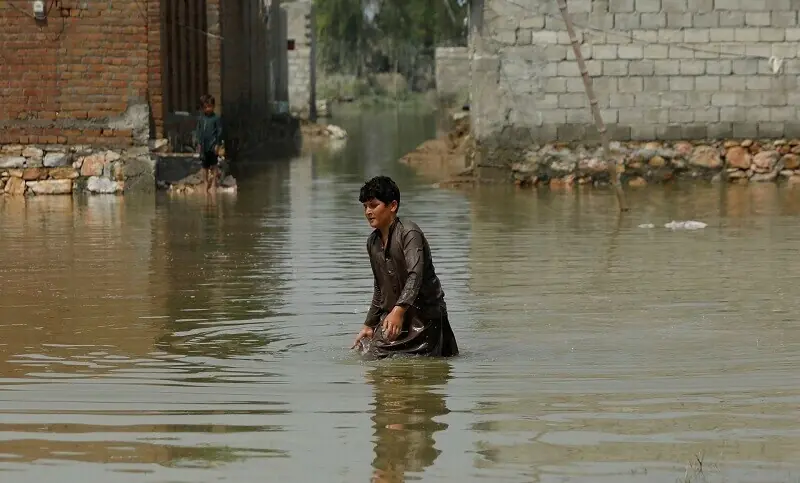
Climate disasters have already inflicted economic losses amounting to $29.3bn on Pakistan’s economy during 1992-2021 (IMF, 2025), whereas the 2022 floods alone caused damages of around $28bn.